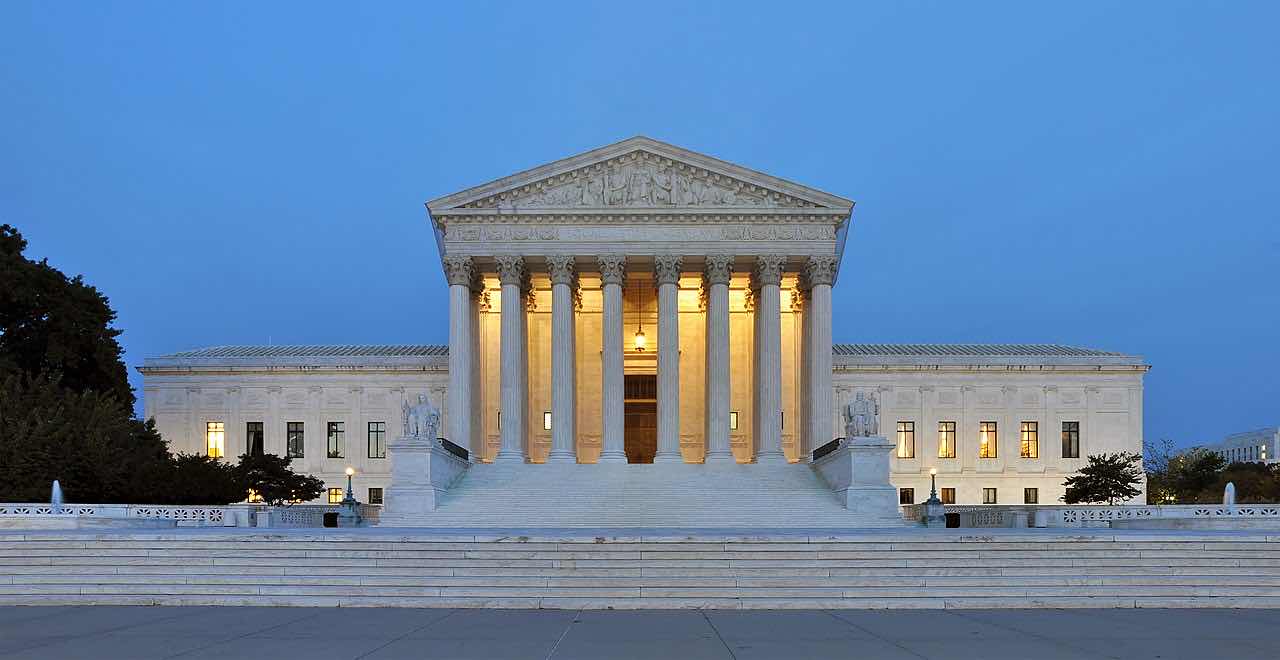
Learn Major Supreme Court Cases
Learn all about the major cases in US Supreme Court history!
50 free flashcards · by Ben · History & Geography / History
Start learning Major Supreme Court Cases for free on Cards
What you'll learn in Major Supreme Court Cases
- Established judicial review, empowering the Court to invalidate laws that conflict with the Constitution. This decision laid the foundation for the modern role of the judiciary. — Marbury v. Madison
- Affirmed the federal government’s implied powers and established the supremacy of federal law over state law. It validated the constitutionality of a national bank. — McCulloch v. Maryland
- Ruled that African Americans could not be citizens and that Congress had no authority to restrict slavery in the territories. The decision deepened national divisions over slavery. — Dred Scott v. Sandford
- Upheld state racial segregation laws under the “separate but equal” doctrine. This decision provided legal justification for segregation for nearly 60 years. — Plessy v. Ferguson
- Declared that segregated public schools are inherently unequal, overturning the “separate but equal” doctrine. It was a pivotal victory for the Civil Rights Movement. — Brown v. Board of Education
- Held that suspects must be informed of their rights (the “Miranda warnings”) before police interrogation. This ruling protects individuals from self-incrimination during custodial interrogations. — Miranda v. Arizona
- Guaranteed the right to legal counsel for criminal defendants in state courts. The unanimous decision ensured fair trials for those who cannot afford an attorney. — Gideon v. Wainwright
- Recognized a woman’s constitutional right to choose to have an abortion. The decision ignited ongoing debates over reproductive rights. — Roe v. Wade
- Limited the scope of executive privilege by compelling President Nixon to turn over tape recordings. It reaffirmed that not even the president is above the law. — United States v. Nixon
- Addressed affirmative action in higher education by allowing race to be considered as one factor in admissions. It struck down rigid racial quotas as unconstitutional. — Regents of the University of California v. Bakke
- Effectively resolved the 2000 presidential election by halting the Florida recount. The decision highlighted the Court’s role in settling contentious political disputes. — Bush v. Gore
- Legalized same-sex marriage nationwide by affirming that marriage is a fundamental right under the Constitution. This decision was a major milestone for LGBTQ+ rights. — Obergefell v. Hodges
- Held that corporate funding of independent political broadcasts cannot be restricted under the First Amendment. This ruling reshaped campaign finance law in the U.S. — Citizens United v. FEC
- Established the “actual malice” standard for libel, particularly for public officials and public figures. The decision greatly expanded freedom of the press. — New York Times Co. v. Sullivan
- Upheld the internment of Japanese Americans during World War II in the name of national security. The ruling is now widely criticized for endorsing racial discrimination. — Korematsu v. United States
- Upheld the constitutionality of compulsory sterilization of individuals deemed “unfit.” The decision has been condemned for its eugenic implications. — Buck v. Bell
- Established the “clear and present danger” test, limiting free speech during wartime. The ruling set important parameters for First Amendment protections. — Schenck v. United States
- Upheld minimum wage laws and marked the end of the Lochner era. It signaled a shift toward permitting greater government intervention in the economy. — West Coast Hotel v. Parrish
- Struck down state laws banning interracial marriage, affirming the principle of equality under the law. The unanimous decision was a watershed moment in civil rights. — Loving v. Virginia
- Held that flag burning constitutes symbolic speech protected by the First Amendment. The ruling underscored robust protections for even the most controversial forms of expression. — Texas v. Johnson
- Struck down laws criminalizing private, consensual homosexual conduct. The decision was a major victory for LGBTQ+ rights and personal liberty. — Lawrence v. Texas
- Extended habeas corpus rights to foreign detainees at Guantanamo Bay. The decision underscored that constitutional protections apply even during national security crises. — Boumediene v. Bush
- Established the “Chevron deference,” granting federal agencies leeway in interpreting ambiguous statutes. This doctrine has had a lasting influence on administrative law. — Chevron U.S.A., Inc. v. NRDC
- Redefined the standards for what constitutes obscenity, thereby allowing states to regulate explicit content. The ruling provided a framework for determining obscenity under the First Amendment. — Miller v. California
- Upheld the regulation of child pornography, even if it might otherwise be protected by free speech. The decision emphasized the state’s interest in safeguarding children. — New York v. Ferber
- Struck down a federal law banning guns near schools, thereby limiting Congress’s power under the Commerce Clause. It was the first such limitation in decades. — United States v. Lopez
- Held that parts of the Violence Against Women Act exceeded Congress’s Commerce Clause authority. The ruling reinforced limits on federal legislative power. — United States v. Morrison
- Recognized that U.S. citizens designated as enemy combatants must be afforded due process. The decision balanced national security interests with individual constitutional rights. — Hamdi v. Rumsfeld
- Held that imposing the death penalty for crimes committed by juveniles violates the Eighth Amendment’s prohibition on cruel and unusual punishment. The decision marked a major reform in juvenile justice. — Roper v. Simmons
- Ruled that mandatory life without parole for juveniles is unconstitutional under the Eighth Amendment. The decision emphasized the need for individualized sentencing for young offenders. — Miller v. Alabama
- Upheld the use of race as one factor in college admissions under strict scrutiny. The decision continues the debate over affirmative action and educational diversity. — Fisher v. University of Texas
- Established the doctrine of selective incorporation by determining which Bill of Rights protections apply to the states. The ruling laid the groundwork for broader due process protections. — Palko v. Connecticut
- Applied the exclusionary rule to state criminal proceedings by barring illegally obtained evidence. The decision significantly strengthened Fourth Amendment protections. — Mapp v. Ohio
- Upheld the constitutionality of “stop and frisk” procedures when officers have reasonable suspicion. The ruling balanced individual rights with the practical needs of law enforcement. — Terry v. Ohio
- Addressed Fourth Amendment rights for students, holding that searches in schools require only reasonable suspicion. It clarified the balance between student privacy and school safety. — New Jersey v. T. L. O.
- Struck down a key provision of the Defense of Marriage Act that denied federal recognition of same-sex marriages. The ruling was a critical step toward marriage equality. — United States v. Windsor
- Ruled that government restrictions on online speech violated the First Amendment. This decision extended constitutional free speech protections to the digital age. — ACLU v. Reno
- Addressed whether wiretapping violated the Fourth Amendment’s protection against unreasonable searches. The decision raised important questions about privacy in a technologically evolving society. — Olmstead v. United States
- Held that government-sponsored prayer in public schools violates the Establishment Clause. The ruling reinforced the separation of church and state in educational settings. — Engel v. Vitale
- Established the “Lemon test” to decide whether a law violates the Establishment Clause. The decision provided clear criteria for ensuring government neutrality in religious matters. — Lemon v. Kurtzman
- Upheld the Civil Rights Act of 1964 by affirming Congress’s power under the Commerce Clause to outlaw racial discrimination in public accommodations. The ruling was a major victory for the Civil Rights Movement. — Heart of Atlanta Motel v. United States
- Held that closely held corporations can be exempt from providing certain contraceptive coverage based on religious beliefs. The decision raised important questions about corporate rights versus employee protections. — Burwell v. Hobby Lobby Stores, Inc.
- Ruled that claims of partisan gerrymandering present non-justiciable political questions. The decision leaves redistricting largely to the political process. — Rucho v. Common Cause
- Upheld the presidential travel ban targeting several predominantly Muslim countries. The ruling highlighted the tension between national security concerns and constitutional rights. — Trump v. Hawaii
- Incorporated the Second Amendment right to keep and bear arms to the states. The decision ensured that individual gun rights are protected at all levels of government. — McDonald v. City of Chicago
- Recognized an individual’s right to possess firearms for lawful purposes unconnected with service in a militia. The ruling was a landmark interpretation of the Second Amendment. — District of Columbia v. Heller
- Struck down several provisions of Arizona’s immigration law as preempted by federal law. The decision reaffirmed the federal government’s primary role in immigration policy. — Arizona v. United States
- Upheld the use of eminent domain for economic development, allowing the government to seize private property for public benefit. The ruling sparked a national debate over property rights and government power. — Kelo v. City of New London
- Resulted in a de facto moratorium on the death penalty by finding its application arbitrary and unconstitutional. The decision forced states to overhaul their capital punishment systems. — Furman v. Georgia
- Reinstated the death penalty under revised sentencing procedures designed to reduce arbitrary results. The decision confirmed that capital punishment is not inherently unconstitutional. — Gregg v. Georgia
More History flashcards
 US State Quarters · 50 cards
 Wars of World History · 245 cards
 History's Greatest Battles · 552 cards
- Explorers in the Age of Discovery · 35 cards
- The Six Wives of Henry VIII · 6 cards
 Chinese Dynasties · 15 cards
 The American Colonies · 222 cards
 Historic Newspaper Publishers · 26 cards