Learn Chemistry Glossary
Learn the most important terms in chemistry!
333 free flashcards · by Ben · Math & Science / Chemistry
Start learning Chemistry Glossary for free on Cards
What you'll learn in Chemistry Glossary
- The science that deals with the materials of the universe and the changes that these materials undergo. — Chemistry
- A process of studying natural phenomena that involves making observations, forming laws and theories, and testing theories by experimentation. — Scientific Method
- A quantitative observation that involves both a number and a unit, such as 5 grams or 10 meters. — Measurement
- A set of tested hypotheses that gives an overall explanation of some part of nature based on observed facts. — Theory
- A statement that expresses generally observed behavior in the natural world, such as the law of gravity. — Natural Law
- The material of the universe; anything that has mass and takes up space. — Matter
- The fundamental unit of which elements are composed; the smallest particle of an element that retains its identity. — Atom
- A substance with constant composition that can be broken down into elements by chemical processes. — Compound
- A bonded collection of two or more atoms of the same element or different elements. — Molecule
- A substance that cannot be decomposed into simpler substances by chemical or physical means, consisting of atoms with the same atomic number. — Element
- A carbon-based material that is soft and slippery, commonly used as the material for pencil lead. — Graphite
- A carbon-based material known for being an incredibly hard gemstone with a rigid crystal structure. — Diamond
- A third form of elemental carbon consisting of hollow, cage-like spheres of atoms. — Buckminsterfullerene
- One of the three states of matter that has a fixed shape and a fixed volume. — Solid
- One of the three states of matter that has a fixed volume but takes the shape of its container. — Liquid
- One of the three states of matter that has neither a fixed shape nor a fixed volume. — Gas
- Characteristics of a substance that can change without the substance becoming a different substance, such as color or density. — Physical Properties
- The inherent ability of a substance to change into a different substance through a chemical reaction. — Chemical Properties
- A change in the form of a substance that does not alter its chemical nature or break chemical bonds. — Physical Change
- The change of substances into other substances through a reorganization of atoms; also known as a chemical reaction. — Chemical Change
- Involves a change in the fundamental components of a substance, resulting in a different substance or substances. — Reaction
- A material with variable composition that contains two or more different substances physically combined. — Mixture
- A substance that contains a mixture of elements and possesses metallic properties, such as brass or steel. — Alloy
- A substance that has a constant chemical composition throughout, such as an element or a compound. — Pure Substance
- A mixture that is uniform and the same throughout; also referred to as a solution. — Homogeneous Mixture
- A specific type of homogeneous mixture where one substance is dissolved in another. — Solution
- A mixture that has different properties or compositions in different regions of the mixture. — Heterogeneous Mixture
- A method for separating components of a liquid mixture based on differences in their boiling points or ease of vaporization. — Distillation
- A method for separating the components of a mixture containing a solid and a liquid using a porous barrier. — Filtration
- One- or two-letter abbreviations used to represent the chemical elements. — Element Symbols
- A principle stating that a given compound always contains elements in exactly the same proportion by mass. — Law of Constant Composition
- A theory stating that elements are made of atoms, all atoms of an element are identical, and atoms of different elements are unique. — Dalton’s Atomic Theory
- The fundamental unit of which elements are composed. — Atom (Repeat)
- A substance with constant composition that can be broken down into elements by chemical processes. — Compound (Repeat)
- A representation of a molecule using element symbols and subscripts to show the types and numbers of atoms present. — Chemical Formula
- A subatomic particle with a negative charge that occupies the space around the nucleus of an atom. — Electron
- The modern concept of the atom as having a dense center of positive charge called the nucleus with electrons moving around it. — Nuclear Atom
- The small, dense center of an atom that carries a positive charge and contains protons and neutrons. — Nucleus
- A subatomic particle located in the nucleus that carries a positive charge. — Proton
- A neutral subatomic particle in the nucleus that is slightly more massive than a proton but has no charge. — Neutron
- Atoms of the same element that have the same number of protons but different numbers of neutrons. — Isotopes
- The number of protons in the nucleus of an atom; this number is unique to each element. — Atomic Number
- The total number of protons and neutrons in the atomic nucleus of an atom. — Mass Number
- A chart showing all the elements arranged so that those in the same column exhibit similar chemical properties. — Periodic Table
- The vertical columns of elements on the periodic table that share similar chemical properties and valence electron configurations. — Groups
- The highly reactive metallic elements found in Group 1 of the periodic table. — Alkaline Metals
- The reactive metallic elements found in Group 2 of the periodic table. — Alkaline Earth Metals
- The highly reactive nonmetallic elements found in Group 7 (17) of the periodic table. — Halogens
- The stable and largely unreactive elements found in Group 8 (18) of the periodic table. — Noble Gases
- The large block of metallic elements in the center of the periodic table where inner orbitals are being filled. — Transition Metals
More Chemistry flashcards
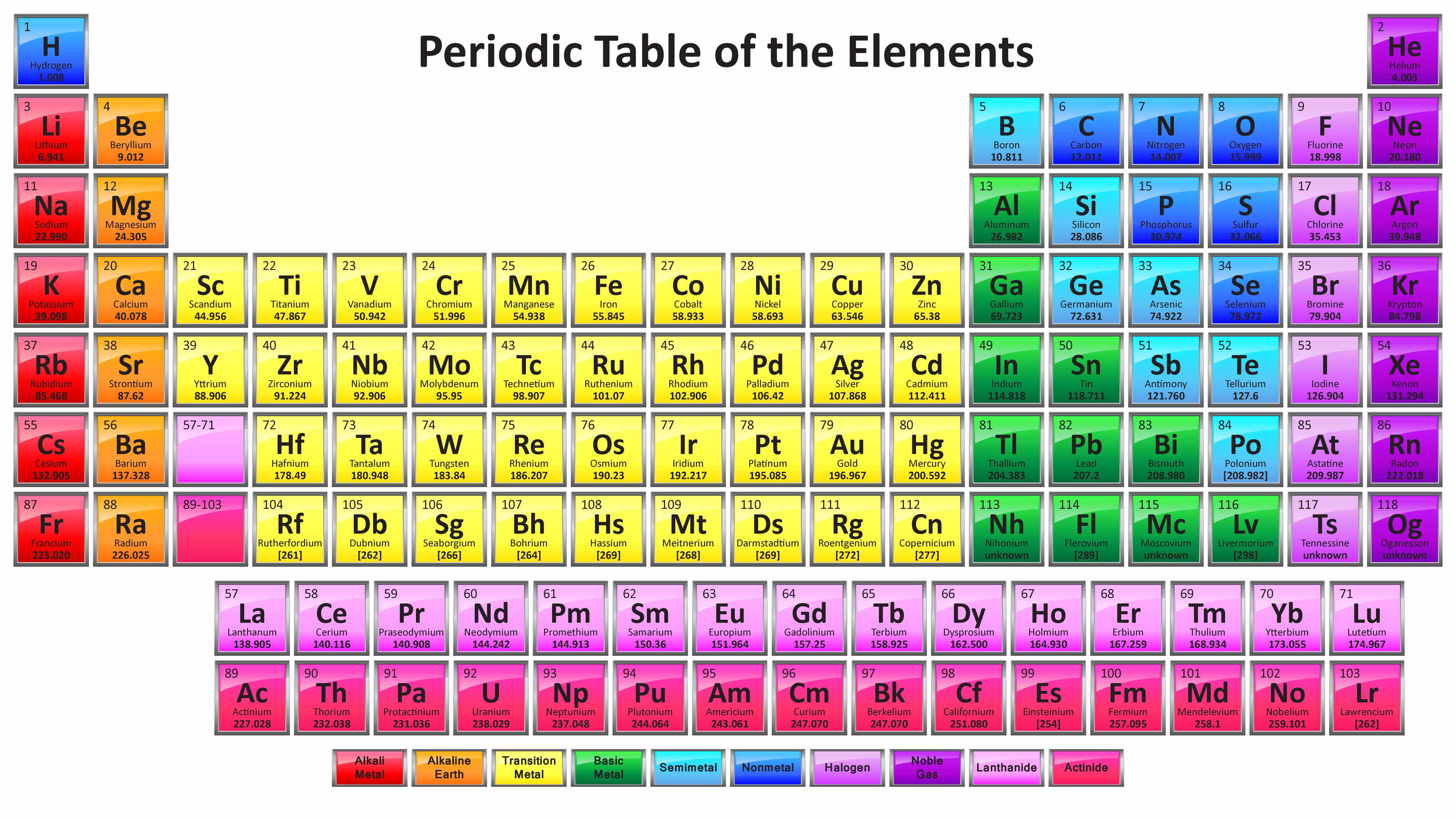 The Periodic Table of Elements · 20 cards
- Alloys · 17 cards
- SI Units · 29 cards
 Atomic Numbers of the Periodic Table · 118 cards